BIO 102 MENU
syllabus 
1 - origin
2 - biomol.
3 - biomol2
4 - viruses
5 - prokaryon
6 - endosym
7 - eukaryon
8 - energy
9 - mitosis
10 - meiosis
11 - reprod
12 - genetics
13 - humgene
14 - humge2
15 - evolution
16 - evolutio2
17 - diversity
18 - diversi2
19 - tissues
20 -digestive
21 - respirat
22 - circul
23 - excret
24 - endocr
25 - receptors
26 - nervsys
Quizzes
Bio 103 Lab
(full title of lecture appears in status bar on the top or at the bottom of your window)




Biology 102 - General Biology
Cell Division
Mitosis
Most of the cells in your body are not dividing and are said to be in interphase. In fact, some of your cells, such as your neurons, are permanently in interphase and will never divide. Interphase is when the work of the cell is being done. Proteins are being made and processed, glycolysis, the Krebs Cycle, photosynthesis, etc. are all carried out in cells that are in interphase.
Examples of cells with the potential to divide are those that line your intestinal tract and those that cover your body. The outer layer of those tissues contain cells that are routinely sloughed off and need to be replaced. The lymphocytes which make antibodies also engage in cell division. All eukaryotic cells divide by a process called mitosis. Actually, mitosis refers to the duplication of the genetic material and the subsequent distribution of exact copies to two new cells. The division of the cytoplasm is called cytokinesis. While most cells undergo both mitosis and cytokinesis at the same time, some do not. For example, your skeletal muscle is a multinucleated tissue which does not contain discrete cell limits, so mitosis occurs without cytokinesis in that tissue.
All of the cells of your body originally came from a single cell, the fertilized egg or zygote. That cell divided repeatedly by mitosis to eventually form the trillion cells that make up your body. Inside each cell is a nucleus which contains the chromosomes. The cell division by which the fertilized egg produces the early embryo is called cleavage. During cleavage there is no cell growth between the cell divisions because the egg contains a very large amount of cytoplasm. Mom packs you a big lunch to last until you are implanted in the uterine wall and the placenta is formed to nourish you until you are born. The egg cytoplasm contains a large number of ribosomes and mitochondria. In fact, all of your mitochondria come from your mother and since mitochondria contain their own DNA (mtDNA), this is known as maternal inheritance. (By studying the sequence of nucleotides in mitochondrial DNA (mtDNA) from a wide variety of humans, scientists have been able to trace our human origins to an African Eve called Lucy.) In order to mold the massive egg into an embryo, the original fertilized egg cell must be divided into smaller units called cells.
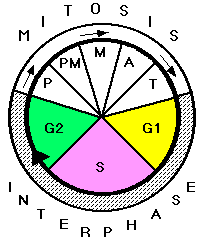
Body cells that are going to divide prepare by going through a cell cycle with several steps. Right after a cell has divided, it must grow to the size of the parent cell. This part of a dividing cell cycle is called G1 (G = growth stage 1). If the cell will never divide (e.g., a neuron) or if it will not usually divide it goes into the G0 stage. Cells may be triggered to move from the G0 back to the G1 and on into the S phase under some circumstances.
When the cell is in interphase the chromosomes are unwound so that they can do their work. In order to make the gene messages, the DNA must be "open" so the enzymes that transcribe mRNA (messenger RNA) from the DNA template can do their job. Chromosomes are composed of DNA wrapped around special proteins called histones. The results are beadlike structures called nucleosomes. A cell in G1 or G0 must be "signaled" to divide and before it can be allowed to prepare for mitosis, one of the cell controls checks the DNA to make sure it does not have damaged DNA. In fact, cells have many controls over mitosis.
Cancer is caused by somatic mutations (mutations in cells of the body) in genes that are responsible for controlling cell division. Usually this requires several mutations since the cellular controls all have backups. Cancer is clonal. It arises from a single cell that has lost the control over cell division and keeps dividing until it forms a tumor or a cancer. These mutations occur with a relatively high frequency and if you live long enough you will probably have some type of cancer. A good immune system can usually rid the body of these disobedient cells.
When the cell receives permission to move out of G1, it moves into the S phase of interphase. In the S phase, the DNA is replicated. The histones are also synthesized since the new DNA must wrap itself around the histones immediately. What began as one chromosome composed of a single double-stranded DNA, becomes two chromatids each with a single double-stranded DNA molecule. The two chromatids are identical to one another and they are joined in a region called the centromere. (Later on, a protein kinetochore will attach to the centromere.)
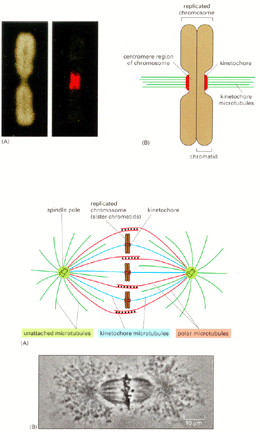
The next, and last, phase of interphase of a dividing cell is called G2. During this time, the cell prepares for mitosis by synthesizing the spindle microtubules and other necessary preparations are carried out.
The beginning of mitosis is called prophase. During prophase, the chromosomes begin to coil more tightly and, as a consequence of the coiling, the nucleolus disappears since it was composed of the elongated DNA coding for ribosomal RNA where rRNA was being transcribed on open DNA. Also, the nuclear membrane begins to disappear, retreating into the ER. The centrioles begin to migrate to opposite ends of the cell where they will serve as the organizing site for the mitotic spindle microtubules. Metaphase is defined as the phase of mitosis when the centromeres and kinetochores are pulled and pushed into the center of the cell. By the end of metaphase they are short, thick flexible rod-like structures attached to the spindle in the middle of the spindle. Their arms may be floppy but the centromere is centered. Anaphase is speedy. During anaphase the two chromatids are separated and pulled and pushed to opposite ends of the cell. By this process, each new cell will receive exactly the same chromosomes as the parent cell had. Telophase is the phase of mitosis where the cell reverses prophase. The nuclear membrane reforms from the ER and the chromosomes decondense.
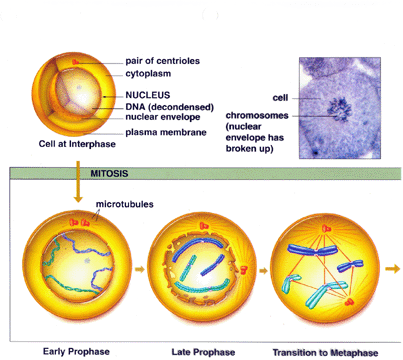
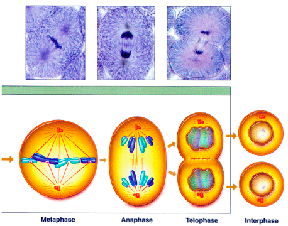
Mitosis in an animal cell
Cytokinesis usually follows and the parent cell is divided into two daughter cells. Cytokinesis involves the action of microfilaments such as actin. In plants a cell wall is laid down between the two new identical nuclei.
Thus, two new genetically identical daughter cells are formed from the parent cell. Eukaryotic cells usually have a number of chromosomes that are divisible by two. This is because sex among eucaryotic organsims involves two parents each contributing equal amounts of genetic material which is carried on chromosomes. Humans have 46 chromosomes. This is referred to as our diploid (2n) number. After mitosis the same number of chromosomes is found in the two new cells as was found in the parent cell. This is called asexual reproduction. Some single celled organisms reproduce primarily by mitosis. In us and other eukaryotic organisms, mitosis occurs after two gametes (e.g., eggs and sperm) combine. The gametes, however, were produced by a similar but slightly different process of cell division called meiosis. We will discuss meiosis in the next lecture.
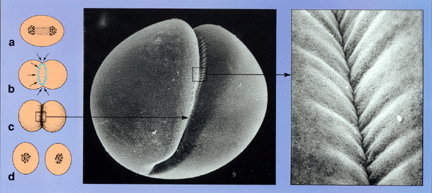
Cytokinesis in an animal cell
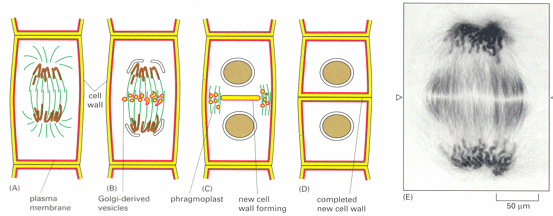
Cytokinesis in a plant cell
