BIO 102 MENU
syllabus 
1 - origin
2 - biomol.
3 - biomol2
4 - viruses
5 - prokaryon
6 - endosym
7 - eukaryon
8 - energy
9 - mitosis
10 - meiosis
11 - reprod
12 - genetics
13 - humgene
14 - humge2
15 - evolution
16 - evolutio2
17 - diversity
18 - diversi2
19 - tissues
20 -digestive
21 - respirat
22 - circul
23 - excret
24 - endocr
25 - receptors
26 - nervsys
Quizzes
Bio 103 Lab
(full title of lecture appears in status bar on the top or at the bottom of your window)





Biology 102 - General Biology
The Diversity of Life
The Five Kingdoms

Not so long ago there were only two kingdoms: Plants and Animals. By 1965, the kingdom Protista was established for those organisms that do not resemble our typical "plants" and "animals" or have characteristics of both. At first it included the bacteria and their relatives, the algae and the fungi. When the electron microscope showed clearly the differences between prokaryotic cells and eukaryotic cells, the kingdom Monera was born and into it was placed all the prokaryotes. A little later the Fungi were put into their own kingdom because of their distinct features and because they did not fit in with Protista, Plants or Animals. Now the kingdoms, Plant and Animal, make a little more sense. All kingdoms except the Monera are made up of individuals with eukaryotic cells.
The Kingdom Monera
The kingdom Monera has a simple criterion for inclusion....you must be a prokaryote. In earlier lectures we have discussed the eubacteria (common bacteria and blue-green algae) and the archaebacteria which are prokaryotes and are, therefore, placed in this kingdom. These two groups are now being separated into separate kingdoms (Eubacteria and Archaebacteria) because their biochemistry is significantly different. The archaebacteria are clearly more related to the eukaryotes biochemically and are now assumed to be the ancestral type.
The Kingdom Protista
The kingdom Protista as it now stands includes the unicellular and a few simple multicellular eukaryotic organisms with no well defined tissues or organs. Since Protista is not a well-defined group, you will still see differences of opinion about what organisms should be included (e.g., algae and slime molds). Some people put the algae in the Plant kingdom and the slime molds in the Kingdom Fungi. We will put both groups in the kingdom Protista but acknowledge that they are on the "borderline." The kingdom Protista is primarily made up of single-celled organisms including the protozoa. These include the amoebae, ciliates and flagellates. Some protozoa which cause human diseases are Giardia, which causes diarrhea; Trichomonas vaginalis which causes vaginal infections; Plasmodium which causes malaria; and trypanosomes which cause sleeping sickness. There are also many single celled algae and multicellular algae. The foraminifera are protists which have external skeletons made of calcium carbonate. The white cliffs of Dover in England were formed from foraminifera shells. Other protists have beautiful internal skeletons made of silica. Algae called diatoms have glassy shells and are found in great quantities in California where the deposits are mined and sold as "diatomaceous earth" often used in filters and fine abrasives.
The Kingdom Fungi
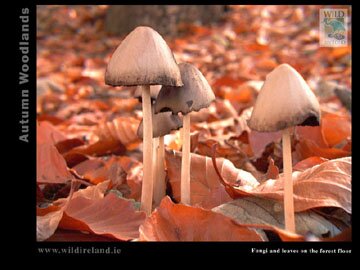
The kingdom Fungi is composed of eukaryotic heterotrophs. The fungi and bacteria are the earth's recyclers or decomposers. The fungi secrete digestive enzymes into their environment and absorb the nutrients through their cell wall and cell membrane. In general, their body plans are built on "hyphae" which are long cellular filaments which are often tightly interwoven to form the body of the fungus. Common fungi are mushrooms, molds, and yeast. Yeast commonly grow as single cells and are useful in the production of wines, beers, and bread. Certain kinds of yeast also cause vaginal infections, especially after a round of antibiotics for a bladder infection. Both of these organisms are always around but without competition by the other, one takes over. Penicillin, the first antibiotic, comes from the fungus, Penicillium. Fungi and bacteria are in competition for the same food sources so it is not surprising that a fungus would make an antibacterial product! Some fungi are pathogens. Athletes' foot is due to infection by a fungus. Fungus occasionally infect toe or finger nails and are very difficult to get rid of. Molds grow on our foods and often spoil our food. They also flavor some cheeses such as bleu cheese, Camembert and Roquefort.
Fungi (left) and Lichens (right)
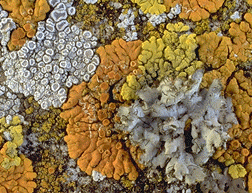
Lichens are a symbiotic association of a fungus and an alga. The alga may be a prokaryotic blue-green alga or a eukaryotic unicellular alga. Lichens, therefore, do not belong in any one kingdom. Symbiosis means "living together." In the case of lichens, the symbiosis is beneficial to both organisms. The fungus supports, holds the moisture, and protects the algae and the algae makes the food for both by photosynthesis. Lichens are often mistaken for mosses which are true plants. In the Arctic, reindeer "moss" is a lichen which serves as food for browsing arctic animals. Because lichens are very sensitive to air pollution, they die in smog polluted areas. There used to be a profusion of lichens in the Santa Monica Mountains but they have all but disappeared. The lichens are often used as indicators of air quality. The difference in the color of the tree trunks on which the white and black moths lived that we talked about in an earlier lecture, is due to the presence (white) or absence (black) of lichens.
The Plant Kingdom
The Plant kingdom is composed of multicellular photosynthetic autotrophs. The criteria to be a plant include having chlorophyll, no locomotion, having tissues and organs including complex sex organs, and producing offspring that as embryos are protected and nourished for a time within the body of the parent.
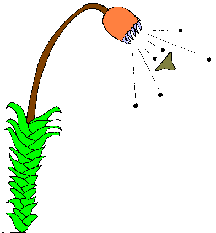
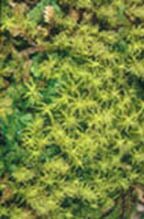
The more primitive plants are dependent on living in water either totally or partially and the more advanced vascular plants have found ways to live independently on land. We can divide the plants into two groups, the bryophytes (literally meaning moss plants) and tracheophytes (plants with trachea or "pipes"). The mosses (and liverworts) are small, fairly simple plants that are usually found growing in very moist locations. Hikers will recognize them as low "fuzzy" plants that grow in or around streams. They must live in these habitats because they do not have water conducting vessels nor do they have true roots. Their sperm cells are ciliated and are released into water to swim to the female sex organs where the eggs are. Their lack of a specialized system for conducting water throughout the plant (trachea) and the need for water for sexual reproduction, are two reasons why mosses are restricted to habitats that at least periodically have abundant moisture. They are to the plant kingdom what the amphibia (frogs and salamanders) are to the vertebrates...both are dependent on water for their reproductive cycle and are, therefore, not true land-based organisms.
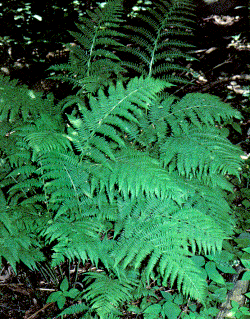
The ferns, gymnosperms and angiosperms (plus related less well known primitive groups such as the horse tails) are the true land adapted plants. They have specialized water conducting vessels or tubes in the plant body. These make up the vascular system. Ferns generally grow in damp, shady locations. Their roots and stems are underground (the rhizome). The leaves, called fronds, grow up from the rhizome each spring. Ferns are dispersed to new locations by means of tiny windblown spores. Earlier in the earth's history, ferns grew in profusion and their remains contributed to the formation of coal. You can often see fossilized imprints of ferns in coal.
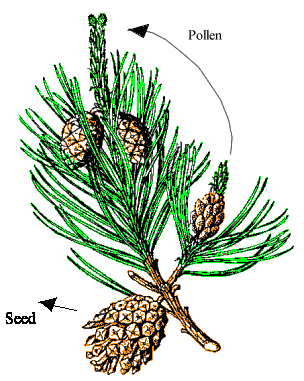
The gymnosperms and angiosperms have stems above ground and roots below. The stems can grow thicker and taller each year and therefore they can reach great heights. Both groups have seeds which are dormant embryos released by the parent plant. The most common gymnosperms are the conifers or "evergreens" with "needle" leaves and seeds produced in cones. These plants supply the majority of our building lumber and paper.
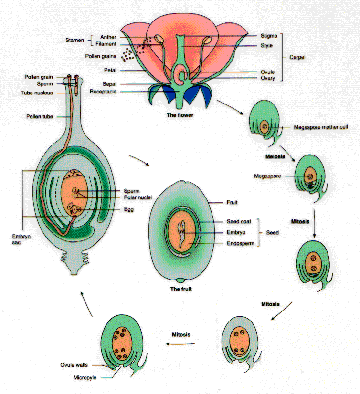
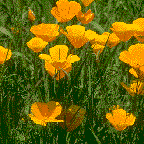
The angiosperms are the flowering plants. The flowers are the organs of sexual reproduction where the seeds are produced. Angiosperm (vessel seed) seeds differ from those of the gymnosperm (naked seed) seeds in being protected by a covering of fruit that develops from the tissues of the flower. The two major groups of angiosperms are the monocots and dicots. The monocots have only one food storage organ called a cotyledon in their seeds while the dicots have two. They can also be distinguished by the fact that the veins in dicot leaves are arranged in a network pattern while in monocots they lie parallel to one another. Another difference is in the multiples of the petals of their flowers. Dicot petals usually occur in fours, fives or some multiple thereof, while monocot petals occur in threes or multiples of threes. The dicots are the larger of the two groups and include most common trees and flowers (maples, elms, tomatoes, roses, etc.). The monocots include lilies, palms, orchids and cereal grains (wheat, rice, corn) upon which we depend so heavily for food.