BIO 102 MENU
syllabus 
1 - origin
2 - biomol.
3 - biomol2
4 - viruses
5 - prokaryon
6 - endosym
7 - eukaryon
8 - energy
9 - mitosis
10 - meiosis
11 - reprod
12 - genetics
13 - humgene
14 - humge2
15 - evolution
16 - evolutio2
17 - diversity
18 - diversi2
19 - tissues
20 -digestive
21 - respirat
22 - circul
23 - excret
24 - endocr
25 - receptors
26 - nervsys
Quizzes
Bio 103 Lab
(full title of lecture appears in status bar on the top or at the bottom of your window)





Biology 102 - General Biology
Animal Structure and Function
The Respiratory System
Gas exchange is important for most organisms with the possible exception of obligate anaerobes. Plants utilize CO2 as a "nutrient" to build more complex organic compounds. They add electrons and H+ (hydrogen ions) to form C6H12O6 (glucose and other molecules) for us and themselves. These electrons and hydrogen ions come from the photolysis of H2O into O2 and electrons e- and H+. So, as we discussed earlier, a plant uses water and carbon dioxide and sunlight to make sugars and oxygen. (Those sugars get modified to form the other required middle-sized biomolecules.)
Therefore, we could say that O2 is a waste product for a photosynthetic organism except for the fact that they as all other aerobic organisms (like us) also use the O2 in the production of their ATP. Simply stated, we need oxygen to "burn" our fuel. This is the same for a car or a candle which both require oxygen to burn their fuel (gasoline and wax). In all organisms, except obligate anaerobes, O2 is absolutely necessary for the production of a sufficient quantity of ATP for life processes. The role of O2 is to function as the ultimate electron acceptor in the electron transport system (ETS) which follows the glycolysis and the Krebs Cycle. The electrons that pass down the ETS, to drive the production of ATP, come from our "food/nutrients" which are "reduced" (reduced means rich in H atoms) organic molecules. Oxygen when it accepts the electrons is converted to O= which combines with the H+ (which lost their high energy electrons in glycolysis and the Krebs Cycle) to form H2O (water). This is called "metabolic" water and its production is what allows the camel to within desert travel when it "burns" the fat in its hump. The utilization of O2, as you remember, takes place in the mitochondria of eucalypts. CO2 (carbon dioxide) is a byproduct of aerobic respiration. It is given off in the Krebs Cycle.
Since the production of ATP is the most important process in our bodies, the need for oxygen is our most important, immediate need. You can go without food for hours, days, weeks, and even months but you can go without oxygen for only a few minutes! People (and other animals) would be "brain dead" soon with the deprivation of oxygen. The CNS suffers first but other tissues will soon follow, for example, the heart.
Every cell in the body of a multicellular organism must be close to the source of oxygen. In many complex organisms, the circulatory system works closely with the respiratory system to deliver the oxygen to every cell of the body and to remove the carbon dioxide which is a waste product.
In thin, simple aquatic organisms that are sedentary, gas exchange is simply by diffusion through the "skin" or outer surface of the body. This type of gas exchange is typical of the sponges, Cnidaria, and flatworms. Even the frog uses its outer surface (skin) for gas exchange although it also has a pair of simple balloon-like lungs.
Respiratory organs must be composed of living cells and therefore must be moist. We cannot breathe through our skin efficiently since it is composed primarily of dead cells. When you hold a mirror up to a person's mouth or nose, you see moisture collect. This shows how much moisture can be lost from a respiratory organ.
As organisms became "thicker" and more active, the need for a more efficient means of gas exchange became greater. The more complex animals that live in the water generally have an out pocketing organ called gills as their respiratory organ. Mollusks, some arthropods, fish and tadpoles (free-living amphibian embryos) use gills.
Terrestrial animals must hide their respiratory surfaces deep within their bodies to prevent desiccation. They all possess inpocketing organs of respiration: either lungs or in the case of insects an elaborate chiton lined system.
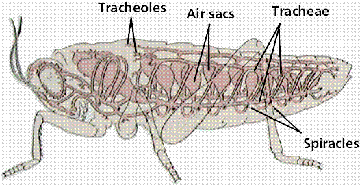
The insects' unique respiratory system is called a tracheal system. There are openings along their bodies called spiracles where oxygen can enter and carbon dioxide leave. The air enters the tracheal pipes which are supported by chitinous rings. These trachea branch repeatedly until they are very thin. Every cell of the insect's body is within one cell distance of the finest branching of the tracheal system. The muscles of their bodies help ventilate, moving the air into and out of the body. Because of their unique tracheal system, the insects are the only group of complex animals that do not depend on a close association of the circulatory system with their respiratory system.
The internal lungs of vertebrates evolved from the air bladder of fishes who at first used it for buoyancy. (This air sac was derived from endoderm of the intestinal tract.). The most primitive lung is found in the amphibians. In them it is a hollow sac (which can be blown up with a straw) and it is not very efficient. The frog must swallow air and force it into the lungs. The frog also uses its skin for gas exchange to supplement the lungs.
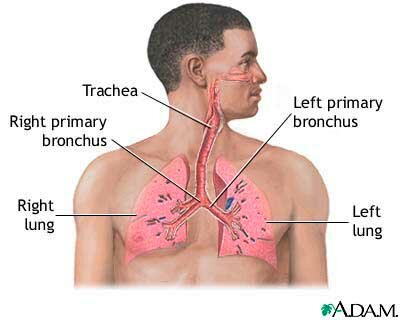
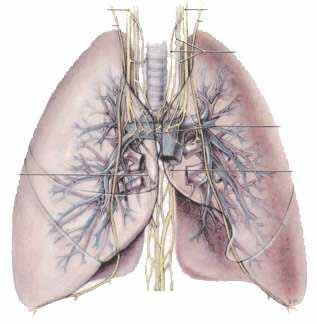
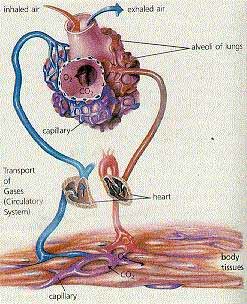
The respiratory tract of terrestrial vertebrates (and aquatic mammals) consists of a nose, a pharynx, larynx, and trachea which lead to the lungs. The trachea is held open by rings of cartilage. The trachea branches into the two lungs and then into smaller and smaller "pipes." The lungs of the fully terrestrial vertebrates are solid but formed of alveoli which when examined individually are similar in appearance to a bunch of grapes. The capillaries of the lungs surround the alveoli and carry carbon dioxide to the lungs and oxygen away from the lungs.
Ventilating devices or behaviors are employed to keep fresh oxygen circulating and to move carbon dioxide away. Sharks (cartilaginous fishes) must continually swim to prevent depletion of the oxygen in waters surrounding them. Bony fish (teleosts) have an operculum over their gills and they swallow water and force it over their gills and out the operculum. As we said, frogs swallow air. The muscles of the rib cage (intercostal muscles) aid in ventilation of the lungs in reptiles, birds and mammals and in the mammals the muscular diaphragm is very important.
