BIO 102 MENU
syllabus 
1 - origin
2 - biomol.
3 - biomol2
4 - viruses
5 - prokaryon
6 - endosym
7 - eukaryon
8 - energy
9 - mitosis
10 - meiosis
11 - reprod
12 - genetics
13 - humgene
14 - humge2
15 - evolution
16 - evolutio2
17 - diversity
18 - diversi2
19 - tissues
20 -digestive
21 - respirat
22 - circul
23 - excret
24 - endocr
25 - receptors
26 - nervsys
Quizzes
Bio 103 Lab
(full title of lecture appears in status bar on the top or at the bottom of your window)





Biology 102 - General Biology
Animal Structure and Function
Tissues, Organs, and Organ Systems
There are functions which every animal and organism, from the simplest to the most complex, must perform. These include the intake of nutrients (digestion in us), respiration or gas exchange, excretion (ridding the body of toxic wastes), coordination of actions (nerves and glands), movement (use of muscles in animals) and reproduction. These functions are carried out by organs and/or organ systems. The organs, in turn, are composed of a variety of tissues. Tissues are associations of similar cells which carry out a specialized function. In general, vertebrates have the same organ systems and tissues.
Tissues
The basic unit of life is the cell and the cells of complex organisms are organized into tissues. Both plants and animals have tissues and organs but we will focus on the tissues and organs of animals, the vertebrates specifically. In vertebrates, tissues are derived from the three layers of the embryo: the ectoderm (outer layer) gives rise to the skin and tissues of the nervous system; the mesoderm (middle layer) gives rise to muscle, bone, and many of the reproductive, urinary and circulatory organs; and the endoderm (inner layer) gives rise to the lining of the digestive tract and organs derived from it such as the lungs. Tissues are composed of cells and extracellular products. Organs are composed of several types of tissues and organ systems are composed of several organs. The organ systems carry out the functions of the body such as digestion, communication, circulation, respiration, excretion, and movement.
Tissues may be categorized into four major types: (1) epithelial, (2) connective tissue, (3) muscle, and (4) nervous tissue. The cells of tissues are held together by one or more of a variety of cell junctions. Some are tight junctions which do not let fluids pass, some are composed of supporting filaments to give the cell shape and to attach the cell to its neighboring cells (adhering junctions), and some, such as the gap junctions, are for intercellular communication.
Epithelial tissues
Epithelial tissues are the linings and covering of surfaces with one side toward the inner (gut) or outer environment (skin) and the other side attached to cells below. For example, epithelium forms the skin, the lining of the digestive tract, glands and the lining of blood vessels. The shapes of epithelial cells vary from cuboidal, to squamous (like pancakes), to columnar (elongated).
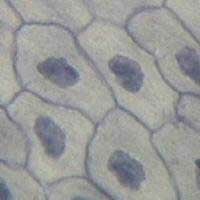
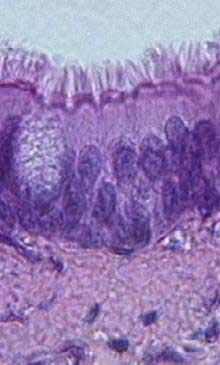
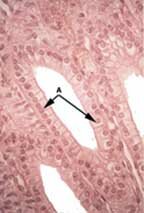
Epithelial Tissue (left to right): squamous, columnar (with cilia), cuboidal (gland)
Connective tissues
The group of connective tissues varies greatly but has in common the fact that they have a cellular component and an extracellular component made by the cells of the tissues. One group of connective tissue contains the loose, dense-irregular and dense regular. All three contain cells called fibroblasts and extracellular collagen. They differ in the amount of flexibility and elasticity of the remaining extracellular "ground substance." The dense-regular type is what ligaments and tendons that work with bones are composed of.
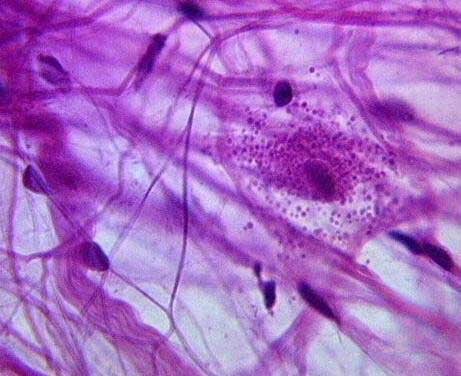

Connective Tissue (left to right): Loose and dense
The more specialized connective tissues are cartilage, bone, adipose (fat) tissue and blood. We have cartilage in our noses and ears as adults but as an embryo and fetus we had cartilage in place of the bones that eventually replaced it. Some cartilage remains at the ends of our bones (if we're lucky). Cartilage and bone also have collagen in their extracellular matrix along with calcium compounds in bone. The internal endoskeleton of vertebrates gives them a huge advantage over other animals such as the arthropods since it can grow with the body and does not need to be shed as exoskeletons must be.
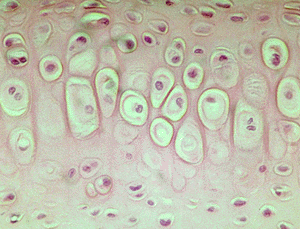
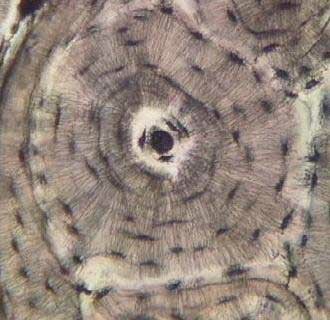
Connective Tissue (left to right): cartilage and bone
Adipose or fat tissue stores the neutral lipids we learned about earlier. This tissue, which is found under the skin, provides protection, warmth and padding. Also, the stored lipids can provide more energy per weight than any other food source. Adipose cells look like a signet ring in cross section with the nucleus being the "stone" and the fat droplets filling the inner part of the ring. Perhaps a balloon within a balloon would better describe the fat cell. The cytoplasm and organelles would be within the space between the inner and outer balloons and the fat droplets in the center in place of the air.
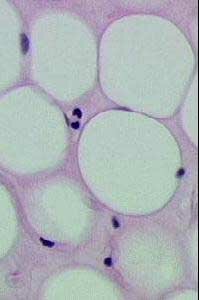
Connective tissue: adipose tissue
Blood is a complex connective tissue with several types of cells and many different biomolecules (e.g., water, proteins and ions) in the fluid plasma portion. The red blood cells contain the hemoglobin which carries the oxygen and carbon dioxide to and from all the tissues of the body. The great variety of white blood cells (leucocytes) are involved in immunity (lymphocytes), blood clotting, fighting infections and disease.
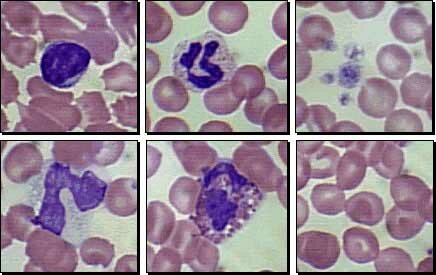
Connective tissue: blood (red cells and white cells)
Muscle tissues
There are three major types of muscle cells. The striated or skeletal muscle is under voluntary control and is the major "effector" organ of our bodies. It and the glands (endocrine and exocrine) carry out all the commands of the nervous and endocrine (communication) systems. Skeletal muscle, as the name implies, is attached to our bony skeleton by tendons and ligaments. There are no individual cells in skeletal muscle. Instead it is a syncytium or mass of cytoplasm with numerous nuclei and filled with the highly organized contractile proteins, actin and myosin. Under the light microscope the very regular arrangement of these proteins is striking and characteristic.
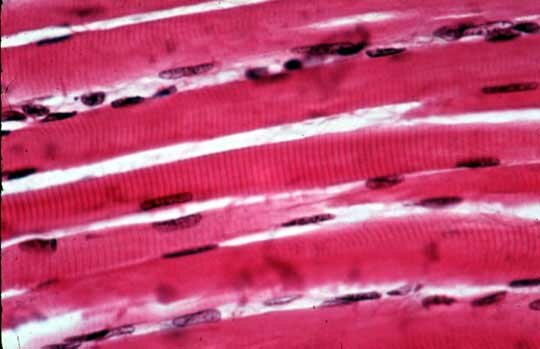
Skeletal Muscle
Cardiac muscle resembles skeletal muscle in the regularity of the structural elements and the last of individual cells. However, it is not under voluntary control. It also has specialized cell end junctions that function in the communications between the various regions of the heart tissue.
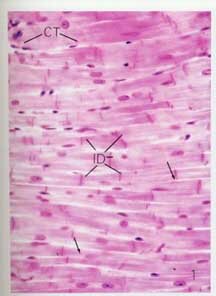
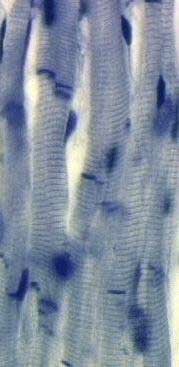
Cardiac Muscle

This is how the microfilaments, actin and myosin, interact to produce contraction in muscle cells
(check your text book for details)
Only smooth muscle has individual cells. It also contains the contractile proteins, actin and myosin, however. Smooth muscle lines the blood vessels and all internal organs. It is not under voluntary control (except for the anal sphincter muscle which we learn to control). Connective tissue covers all three types of muscle.

Smooth Muscle
Nervous tissues
Nervous tissue is found only in animals beginning with the Cnidaria. The nervous system in vertebrates is composed of neurons which are the impulse conducting cells and the variety of supporting cells collectively referred to as neuroglia. Neurons have a cell body which refers to that part of the cell in which the nucleus is situated. Some have extensions called dendrites and axons. The axons can be several feet long, reaching from your spinal column to your big toe. The axons are supported structurally by microtubules. There are many kinds of neurons depending on their location within the nervous system. There are sensory, integrative, and motor neurons. They can be in the central nervous system (CNS, brain and spinal cord) or peripheral nervous system (PNS, cranial or spinal nerves).
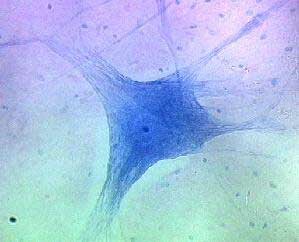
A Neuron
Cells connect with one another to form a tissue via a variety of junctions. Individual cells may have more than one type of junction. These may join the cells very tightly (tight junctions), as in the intestine, so that the bacteria cannot penetrate. Other junctions facilitate the flow of molecules such as calcium between cells (gap junctions). Others act like "staples" to hold the cells together in the tissue (adhesion junctions).

Organ Systems
The major organ systems of the body and their functions are the (1) integumentary system for protection, excretion, receipt of external stimuli (outer covering of skin); (2) muscular system for movement, posture, heat production;

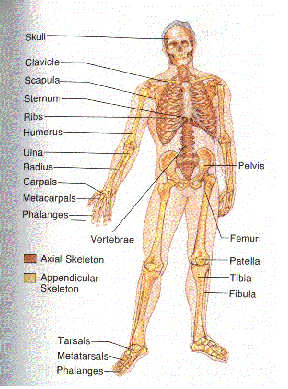
The Muscular System and the Skeletal System
(3) skeletal system for support, muscle attachment, red blood cell (rbc) production, Ca++ and PO4-- storage; (4) nervous system to rapidly detect external and internal stimuli and coordinate responses;
(5) endocrine system which produces hormones to complement the nervous system in the control of body functions. Hormonal coordination which is coordination by biochemicals secreted and detected by specialized cells is the most ancient form of intercellular communication. It is used by every type of organism including the Monera.


The Endocrine System (in Greek) and the Circulatory System
(6) circulatory system functions to deliver biomolecules (including gases) to and pick up waste or toxic biomolecules from all cells of the organism. In vertebrates it is a "closed" system and works in close conjunction with the respiratory system.

The circulatory system showing the major blood vessels
(7) The lymphatic system works in conjunction with the circulatory system to assist in picking up excess fluid (lymph) released by the circulatory system (capillaries) into the tissues. It is an "open" system which begins in the tissues not with arteries and arterioles. When lymph vessels are blocked by parasites such as the roundworm, Wuchereria bancrofti, a condition known as elephantiasis results. As the name implies, the portion of the body affected reaches elephantine size.

The Lymphatic System
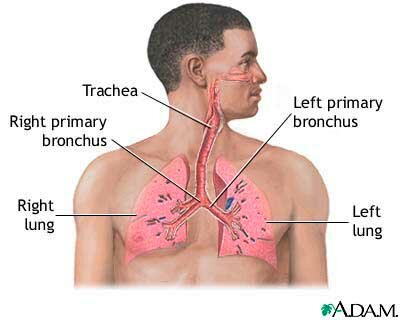
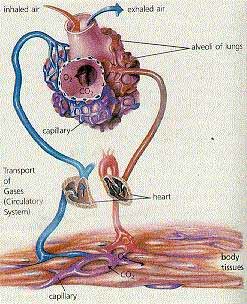
The respiratory system
(8) The respiratory system functions in the exchange of the gases, oxygen and carbon dioxide. In vertebrates the blood vessels of the lungs bring deoxygenated blood into the lung and carry away oxygenated blood. Carbon dioxide is downloaded in the lung as well.
(9) The digestive system functions to process nutrients for energy and as building blocks for the body. Large pieces of food are systematically broken down to smaller units and eventually chemically broken down into biomolecules which can be absorbed in the gut and into the circulatory system. The undigested remains are eliminated.
(10) The urinary system has the job of maintaining a constant internal environment. Through it passes the blood for filtering and maintenance of osmotic equilibrium, the retention of valuable nutrients and the excretion of excess or toxic molecules.
(11) The reproductive system is differentiated into male and female and consists of gonads and appropriate internal and external "plumbing" or ducts. Its job is to produce gametes (eggs or sperm) and to deliver them to the appropriate site for fertilization. Depending on whether the organism has internal or external fertilization or internal or external development of the embryo, additional organs are added as necessary. The gonads produce both gametes (exocrine function) and hormones (endocrine function). The sex hormones influence (target) other organs as well (e.g., skin, muscle, breast, uterus, phallus, etc.)
