BIO 102 MENU
syllabus 
1 - origin
2 - biomol.
3 - biomol2
4 - viruses
5 - prokaryon
6 - endosym
7 - eukaryon
8 - energy
9 - mitosis
10 - meiosis
11 - reprod
12 - genetics
13 - humgene
14 - humge2
15 - evolution
16 - evolutio2
17 - diversity
18 - diversi2
19 - tissues
20 -digestive
21 - respirat
22 - circul
23 - excret
24 - endocr
25 - receptors
26 - nervsys
Quizzes
Bio 103 Lab
(full title of lecture appears in status bar on the top or at the bottom of your window)





Biology 102 - General Biology
Cell Division
Meiosis and Sexual Reproduction
There is a special kind of cell division that occurs exclusively in the gonads (ovaries and testes) of eukaryotic organisms. This special cell division is called meiosis. In the ovary it is referred to as oögenesis and in the testes as spermatogenesis. Meiosis produces the gametes called eggs (ovum, sing., ova, plural) and sperm. It involves two cell divisions and therefore four cells result from each meiotic event. The primary oöcytes and spermatocytes are originally produced by mitosis but then enter Meiosis I followed by Meiosis II.
In human (and other mammalian) females, oögenesis begins during fetal development and is arrested in the Metaphase I until the time of ovulation. Fertilization triggers the completion of Meiosis II in the oöcyte. Ovulation ends with menopause. In human (and other mammalian) males, spermatogenesis begins with sexual maturity (puberty) and does not stop. Chromosome errors are more common in the egg as the female gets older and gene mutations are more common in the sperm as the male gets older.
Chromosome errors increase with increasing maternal age
The purpose of meiosis is to produce haploid (1n) gametes. Another purpose is to recombine genes from the parents of the individual in whom meiosis is occurring. Both the reduction of the chromosome number from 2n to 1n and the recombination of genes is accomplished in an amazingly simple way. After the DNA is replicated in the S phase preceding meiosis, the homologous chromosomes (each composed of two chromatids) pair up in Prophase I and then crossing over, breakage and reunion occurs between the two homologs thereby ensuring recombination of genes between the two homologs. At Metaphase I of meiosis, the homologous chromosomes (each still composed of two chromatids) line up on the metaphase plate. Therefore, in meiosis, the chromosomes must "go to the (meiosis) dance" with a partner. You may recall that in mitosis, the homologous chromosomes do not pair up with their homolog and that they each "go to the (mitosis) dance" alone. The pairing of homologous chromosomes in meiosis assures that the resulting gametes have a wide variety of gene combinations and that they receive only one member of each pair of chromosomes. The new combinations of genes are due both to the crossing over, breakage and reunion between the homologs and the random assortment of maternal and paternal homologs along the metaphase plate. The pairing up of homologs is what also assures that in meiosis there will be a reduction of the number of chromosomes from 2n to 1n, with one member of each homologous pair in the gamete.
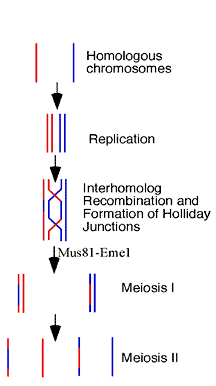
The homologous chromosomes must pair up gene for gene. Each homolog has already duplicated and is composed of two chromatids. The chromatids crossover, break and rejoin. At least one crossing over event per chromosome arm is obligatory for successful meiosis. Thus the resulting chromatids (soon to be chromosomes) contain genes from both the parents (of the individual who is making the gamete). Each chromosome in the gamete will then contain a new arrangement of genes with some from each parent homolog. Another source of variation is provided since we have two parents who contribute different genes to the offspring. Sex is any mechanism which results in the recombination of genes to provide variation in the offspring. The new combinations of genes in the offspring may prove to be more successful.
At Metaphase I the pairing brings the centromeres of the paired homologs to the metaphase plate in the center of the cell where the homologs separate (still composed of two chromatids) during Anaphase I. Telophase I is short and results in the formation of two cells each with one member of each homologous pair and still composed of two chromatids. There is no DNA replication after Telophase I prior to Prophase II.
Meiosis II resembles mitosis because it is here that the chromatids separate. In Metaphase II the chromosomes, each composed of two chromatids, line up in the center of the spindle and in Anaphase II, the two chromatids separate. In Telophase II, cytokinesis gives rise to two cells from each of the two cells resulting from Meiosis I for a total of four cells from the original cell. In spermatogenesis, all four resulting cells form functional spermatocytes. In the female, in oögenesis, only one of the four becomes the functional oocyte. The other three cells are called polar bodies and are discarded.
Sperm and eggs from the same species have the same number of chromosomes. However, the sperm is specialized for motility and has a nucleus to hold the chromosomes but has almost no cytoplasm. It is equipped with a flagellum (cilia in some organisms) and mitochondria to provide energy for the motility. The egg, on the other hand, accumulates an unusually large amount of cytoplasm which is filled with ribosomes, mitochondria, and nutrients (yolk) to provide sufficient nutrients during cleavage of the zygote to form the embryo. The fertilized egg is called the zygote. The zygote undergoes mitosis known as cleavage to form the embryo. There is no growth until later.
To emphasize the importance of pairing of homologous chromosomes for the success of meiosis, we will learn about two instances when meiosis fails. Mules are interspecies hybrids from a horse mother and donkey father. (A hinny is the result of the opposite cross.) The diploid number in the horse is 64 (2n=64) and the diploid number in the donkey is 62 (2n=62) The fertilization of the horse egg (n=32) by the donkey sperm (n=31) gives rise to a zygote with 63 chromosomes which successfully undergoes mitosis to form the mule. During mitosis, there is no need for homologous chromosomes, however, when meiosis is attempted in the mule gonad, there is a need for homologous chromosomes to pair up. The horse and donkey chromosomes are not homologous, nor are there an even number of chromosomes so pairing cannot occur. Therefore meiosis is unsuccessful and the mule is sterile.
Another example concerns the "seedless" watermelon. Since plants, unlike animals, do not mind having extra sets of chromosomes tetraploid (4n) watermelons can easily be created. There are diploid (2n=22); triploid (3n=33), and tetraploid (4n=44) watermelons. When the tetraploid plant (4n =44) undergoes meiosis, it makes gametes with a diploid number, of chromosomes (2n=22). An ordinary watermelon is 2n=22 and makes gametes which are n=11. If you cross a 4n, tetraploid watermelon with a 2n, diploid watermelon, you will get a 3n, triploid watermelon. The 2n egg (or sperm) combines with a 1n sperm (or egg) and a 3n zygote is formed which divides by mitosis to form a 3n, triploid watermelon. All is well until the 3n, triploid watermelon attempts meiosis. Since there is more than a pair of homologous chromosomes the required pairing and recombination cannot occur, and, therefore, meiosis fails. The 3n, triploid watermelon thus fails to form viable seeds. Instead it produces small rudimentary, white, infertile seeds and the watermelon is referred to as seedless.
Comparisons between mitosis and meiosis
Homologous chromosomes pair up in meiosis but not in mitosis
