BIO 102 MENU
syllabus 
1 - origin
2 - biomol.
3 - biomol2
4 - viruses
5 - prokaryon
6 - endosym
7 - eukaryon
8 - energy
9 - mitosis
10 - meiosis
11 - reprod
12 - genetics
13 - humgene
14 - humge2
15 - evolution
16 - evolutio2
17 - diversity
18 - diversi2
19 - tissues
20 -digestive
21 - respirat
22 - circul
23 - excret
24 - endocr
25 - receptors
26 - nervsys
Quizzes
Bio 103 Lab
(full title of lecture appears in status bar on the top or at the bottom of your window)





Biology 102 - General Biology
The Origin of Life
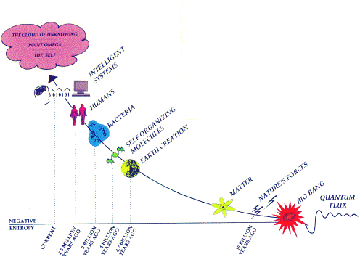
Geochemical studies have provided overwhelming evidence that our solar system including our planet, Earth, was formed about 4.5 billion years ago (BYA). The current most commonly accepted theory of the formation of the moon is the "Big Whack" theory. It says the moon was formed from the left overs from Earth's collision with another planet-like body somewhat larger than Mars. On impact with the earth big chunks of the terrestrial mantle were hurled into space to form the moon along with residues of the impactor body.
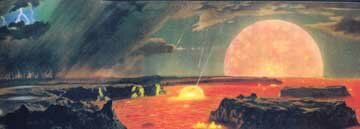
The primitive earth was very inhospitable to life as we know it. It was extremely hot with a lot of volcanic action and the sunlight's UV light was not filtered out since the unprotected earth had no ozone layer or cloud cover. The early atmosphere was a gaseous mixture of ammonia (NH3), nitrogen (N2), hydrogen (H2), carbon dioxide (CO2), carbon monoxide (CO), methane (CH4) and liquid water (H2O). This highly reducing atmosphere was devoid of free oxygen (O2).
Urey and Miller in 1952, and others later, dramatically demonstrated that under conditions which mimicked the primitive earth, using an appropriate energy input, an array of organic molecules could be produced. On the primitive earth, these molecules accumulated to form an "organic soup"...an ocean rich in organic molecules. From this rich pre biotic "soup," life evolved. It was a relatively short interval (one billion years) that a plethora of experiments resulted in the formation of living organisms about 3.8 BYA. Evidence of the success of these early experiments are the microfossils that date back 3.5 BYA.
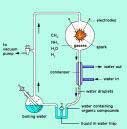
The first organisms were thermophilic (heat loving) anaerobes, meaning they lived in a very hot world with an atmosphere devoid of free oxygen. In fact, oxygen would have been poisonous to them. Even today we take "antioxidants" to protect us from the harmful effects of too much oxygen. These anaerobic cells flourished on the surface of the planet for more than 500 million years before oxygen began to play a role in the evolution of life as we know it. The earliest cells are called prokaryotic cells which are the simplest of cells. The more complex eukaryotic cells, of which we are composed, evolved later. (We will discuss these cells types in more detail in future lectures.)
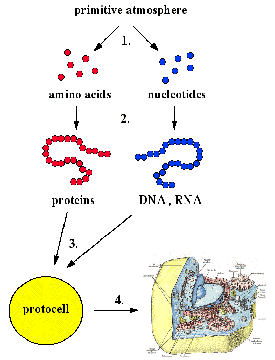
The free oxygen originated, as it does today, from photosynthesis where H2O is broken down to form oxygen (O2) and hydrogen ions (H+). And also, as today, the important part was the formation of hydrogen ions which were used to reduce carbon dioxide to form organic molecules (the building blocks of plants and animals). The oxygen was toxic and the earliest cells had to learn to cope with this "poison." Some of the early cells learned to "detoxify" oxygen and then some eventually learned to use oxygen for their benefit. We are now dependent on it to "burn" (oxidize) food molecules to produce energy. (We will learn more about energy production in a future lecture).

THE PORPHYRIN RING ABOVE APPEARED EARLY IN CHEMICAL EVOLUTION
It has a Mg (magnesium) ion at its center in the chlorophylls and it appears later in the cytochromes of electron transport enzymes and also in hemoglobin, our oxygen carrying protein, where is contains an iron ion, Fe, in place of the Mg
These first organisms were also heterotrophs (other feeders). (We are also heterotrophs.) These early cells used the "organic soup" to obtain molecules to make more of themselves and to break down for energy. When the "organic soup" became depleted there was selection for those organisms that could manufacture their own food. These organisms are called autotrophs (self feeders). Photosynthesis is an example of a process for making organic molecules to be used as food, both for the organism and for those who eat it. One of the early molecules that was formed was chlorophyll which plays an essential role in photosynthesis by capturing light energy to break down water molecules. The porphyrin ring it contains has magnesium (Mg) in the center. We have a similar organic structure in hemoglobin, our blood protein that carries oxygen. We have iron (Fe) in the center of our porphyrin ring instead of magnesium (Mg). It is interesting how evolution is very conservative, using similar molecules in a variety of functions. We see this over and over in biology. (We will discuss "biomolecules" in a future lecture.)
The presence of abundant oxygen in the atmosphere stopped any further production of organic molecules in the environment and also any new "experiments" in the formation of living cells. Any such de novo synthesis of organic molecules is no longer possible. The molecules would be eaten by an existing organism or oxidized by the oxygen-rich atmosphere. The ability to utilize oxygen to gain more energy, however, resulted in a blossoming in the variety and complexity of organisms on earth. By 500 million years ago there were multicellular organisms and most major animal phyla had appeared. Humans (and their immediate ancestors) appeared only within the last one to two million years!
