BIO 102 MENU
syllabus 
1 - origin
2 - biomol.
3 - biomol2
4 - viruses
5 - prokaryon
6 - endosym
7 - eukaryon
8 - energy
9 - mitosis
10 - meiosis
11 - reprod
12 - genetics
13 - humgene
14 - humge2
15 - evolution
16 - evolutio2
17 - diversity
18 - diversi2
19 - tissues
20 -digestive
21 - respirat
22 - circul
23 - excret
24 - endocr
25 - receptors
26 - nervsys
Quizzes
Bio 103 Lab
(full title of lecture appears in status bar on the top or at the bottom of your window)





Biology 102 - General Biology
Evolution II
The Evidence and Reasoning
Comparative Anatomy
Darwin and Wallace were well educated and aware of the most recent scientific knowledge. They were acquainted with the work of comparative anatomists and their knowledge of homologous organs. In comparing vertebrate anatomy, it was obvious that certain parts of the body are built to the same basic plan. This would not be surprising if the similarly constructed parts were used in similar ways. However, the organs were often used in a variety of ways. The forelimbs of the chicken and bat were used for flying, the forelimbs of the horse for running, the whale for swimming, and of the human for a variety of manipulations. The persistence of the basic pattern of the forelimb was interpreted as evidence of inheritance from a common ancestor with subsequent modifications as adaptations of the forelimb to the special needs of the organism to survive. These various vertebrate forelimbs are one example of homologous organs.
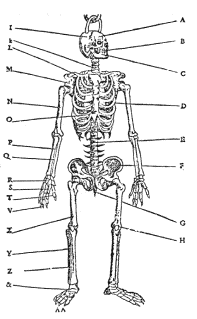
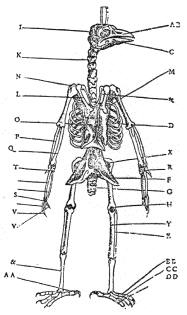
The more recent two species have shared an ancestor, the more homologous organs they will have in common. The dog and the coyote share many more homologous features than the dog and humans. There are some homologous organs which in some animals have no apparent function. Dissection of a boa constrictor or a whale reveals bones that are thought to be homologous to the hip bones of other vertebrates yet they have no function. Humans, too, have vestigial organs. The fused vertebrae which make up the base of the human spine are the vestigial remnants of the tail of our ancestors. In fact, human babies occasionally are born with short tails which are quickly and easily remove. Our appendix is also a vestigial organ.
Analogous organs are those that serve the same purpose. They may or may not be homologous. Often when organisms adapt to the same environment they have organs that look similar and function similarly. Examples of analogous organs are the fins of fishes, penguins and dolphins. These analogous appendages all serve the function of propelling the animals through water. However, the forelimbs of the penguin and dolphin may also be homologous but the fins of a fish are not homologous to the others.
Comparative Embryology
The study of comparative embryology also supplied evidence of the relatedness of organisms. The study of embryos of vertebrate organisms revealed striking similarities in their early development. In fact, the early embryos of vertebrates are difficult to distinguish. Examination of the embryos of land mammals has shown that they have branchial grooves ("gills") in the neck region and gill pouches on the interior. In the fishes these structures form the gill slits through which water moves from the pharynx, over the gills and out of the body. Sometimes human babies are born with left over small pits in the neck area. The chief trace of their existence is the Eustachian tube and auditory canal, which connect the pharynx with the outside of the head. The gill supports are converted into the inner ear ossicles. The temporary possession of tails in human and ape embryos and the formation first of a two chambered heart early in development are other examples of developmental stages through which the human embryo passes. The evolutionary explanation is that we and the other vertebrates continue to pass through many (not all) of the embryonic stages that our ancestors passed through because we have all inherited developmental mechanisms from a common ancestor. We then go on to modify these in ways appropriate to our diverse ways of life. The differences among the vertebrate embryos became evident only at later stages of embryonic development. These phenomena are expressed by the saying that "ontogeny tends to recapitulate phylogeny." In other words, the ontogeny or development of an organism goes back through its evolutionary past. Homologous organs have derived from the same embryological structures.
Geology and Paleontology
Darwin and Wallace knew a lot about geology and paleontology which is the study of fossils. A fossil is any sort of remains of a once-living organism. Sometimes the whole body is preserved as in amber (hardened tree sap). The movie, Jurassic Park, capitalized on the fact that insects are trapped in amber. In the movie, the mosquitoes in the amber contained dinosaur blood. The scientist in the movie extracted dinosaur DNA from the dinosaur blood and recreated entire dinosaurs from the DNA.
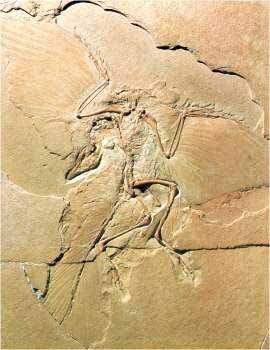
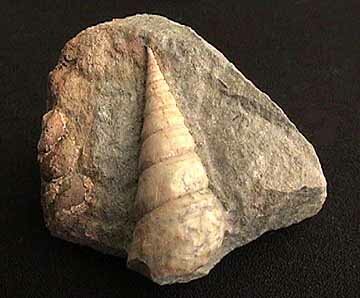
Single celled organisms and soft bodied animals are not as likely to be found as fossils. Usually only animals with "hard parts" such as bone and shell are preserved. If surrounded by sediments of clay or sand, they may yield easily recognizable fossils 500 million years later, long after the enclosing sediments have turned to rock such as shale or sandstone. These fossils may even retain traces of organic matter such as amino acids and even DNA from over 300 million years ago. Fossils may be a mold, cast or imprints. The Petrified Forest in Arizona is an example of a replacement type of fossil formation. As the original disintegrates, it is replaced bit by bit with mineral deposits. Amazing detail can be seen in these fossils. The fossil, Archaeopteryx, is an example of a "missing link" between the birds of today and the reptiles from which we believe they evolved. Coal is a fossil fuel and one can often see the imprints of fern-like leaves in the coal. Fossils provide direct evidence of ancestral forms of present day organisms. Chemistry has provided the means of dating fossils by using the rate of radioactive decay as a measure of time.
Comparative Biochemistry
Comparative biochemistry was unknown to Darwin and Wallace since the science had its beginning in the mid 1900's. Had they known about it they would have been very excited for this area provides the most compelling evidence of all for evolution. Just as the study of comparative anatomy has shown the presence of anatomical homologies, so the study of the biochemistry of different organisms has revealed biochemical homologies.
Central to the argument for the common origin of all life on our planet is the fundamental fact that DNA and its four bases is the genetic material of all organisms. The genetic code is the same in all organisms as evidenced by the fact that bacteria can read (translate) human genes (mRNA) on their ribosomes with their tRNAs to make human proteins such as insulin.
DNA hybridization (exploiting the fundamental principle of complementary base pairing) studies have been used to reveal the relationships between species that could not be resolved by other means. DNA hybridization involves the "melting" of the DNA or separation of the two strands of the DNA molecule from two different species and allowing them to re anneal the speed and completeness of the association of DNA from different species is a measure of how similar the sequences of bases are in their respective DNA. So the DNA of humans and apes re anneals more quickly and completely than the DNA of humans and horses.
The biomolecules you have learned about early in this course are the same in all organisms. All organisms have polysaccharides, lipids, nucleic acids and proteins. Their proteins are all made from the same twenty amino acids. Cytochrome enzymes are used for electron transport in all organisms ranging from the most primitive to the most complex of organisms. Chlorophyll a is found in all great plants and almost all photosynthetic Protista. All eukaryotic organisms have almost identical histones around which the DNA is packaged into chromosomes. Actin molecules which are responsible for cellular movement are another group of highly conserved proteins.
Glycolysis and the Krebs Cycle are carried out in all cells using the same enzymes. The genes in yeast, a unicellular fungi, and humans are so similar that the functions of genes involved in several genetic disorders have been elucidated by the study of the homologous genes in yeast.
All Living Things are Related
Evolution says that all species, past and present, are related and have the first cells on Earth as their ancestors. Our next step is to explore the evolutionary relationships among the organisms present on earth. Taxonomy is based on phylogenetic relationships. Each organism has a two-part name, genus and species: Homo sapiens. (Members of different species, in general, cannot interbreed.)
The Five (or Six) Kingdom System
We will use the five kingdom system, however, the six kingdom system which was arrived at by comparative biochemistry studies will soon replace it. The biochemistry of the Archaebacteria and Eubacteria is quite distinct and the idea that Eukaryotes arose from an archaebacteria ancestor is compelling. As short a time ago as 1950's, there was a two-kingdom system and every organism was squeezed into either the Kingdom Plants or the Kingdom Animals. We will use these groupings: Monera (Archaebacteria and Eubacteria), Protista, Fungi, Plants, and Animals.

